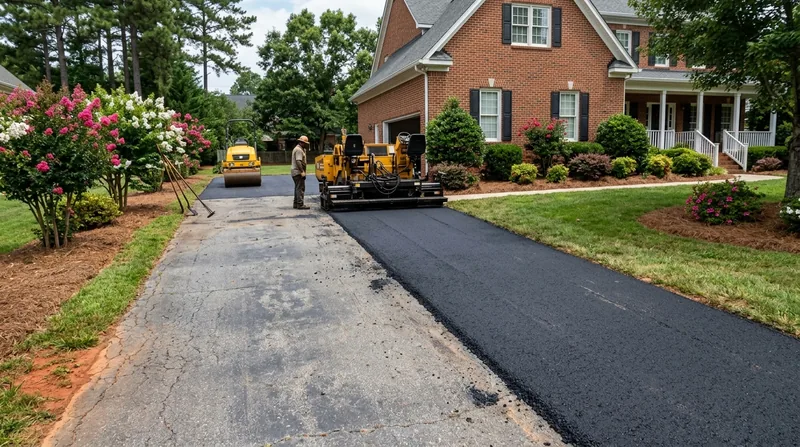




The Piedmont Triad's red clay, 45 inches of annual rain, and freeze-thaw winters create a specific asphalt failure pattern: freeze-thaw cracking and edge undermining from water infiltration, combined with summer oxidation that hardens the binder and opens the surface to water damage. Driveways in Greensboro's older neighborhoods (Fisher Park, Starmount, Sedgefield) and the sprawling 1980s-2000s subdivisions in Summerfield and Adams Farm are reaching the ten to fifteen year mark where the surface has lost integrity but the base remains sound. Asphalt resurfacing and overlay in Greensboro is the practical middle path: a new 1.5 to 2 inch compacted surface course over a structurally sound base, restoring drive life without the cost and disruption of full replacement. We mill the edges flush at the garage and street, level surface cracks, and tie the new course in tight so water cannot work underneath. The result is a driveway that looks new and functions new, at roughly 40 to 60 percent of replacement cost. Call Greensboro Asphalt Paving at (336) 962-5692 for a free estimate, or read on to understand when overlay makes sense and when your driveway actually needs replacement.
Why Asphalt Overlay Matters in Greensboro: Base Failure vs. Surface Failure
The critical question is whether your driveway's base is still solid. If the top layer has cracked, oxidized, and started to fail, but the subbase remains compacted and well-drained, an overlay restores the surface without excavation. If the base has failed (the driveway is soft, sinks under weight, or shows alligator cracking across thirty to forty percent or more of the surface), an overlay will fail within three to five years because it has nothing sound to bond to. In Greensboro's climate, base failure typically comes from years of water infiltration under edge cracks or from inadequate initial base preparation on older residential drives.
- We inspect the base by probing and measuring deflection to confirm the subgrade is still bearing load.
- Surface cracks alone, or cracking in less than thirty percent of the area, are candidates for overlay.
- Alligator cracking, soft spots, or a driveway that sinks under vehicle weight signals base failure and requires full-depth replacement instead.
- Edge undermining from water running under the asphalt is common in Greensboro after freeze-thaw winters and is repaired as part of the milling and edge-mill process.
Knowing the difference keeps you from spending money on an overlay that will not hold. We tell you what the driveway actually needs before you commit.
Key info: Sedgefield and Starmount driveways built in the 1950s and 1960s often have solid bases but severely oxidized surfaces. These are ideal overlay candidates. Newer subdivision drives in Adams Farm or Jamestown, if built on inadequate base prep, may fail at the base even if they appear sound on top.
For more detail on when to repair versus replace, see our guide to driveway repair in Greensboro.
How Asphalt Overlay Works: The Process from Mill to Compaction
An overlay is a controlled sequence. We start by milling the existing surface edges at the garage threshold and street line so the new course ties in flush and water does not pool at the joint. We then fill and level any significant surface cracks with hot-mix asphalt, proof-roll the base to confirm it bears weight evenly, and lay the new 1.5 to 2 inch surface course in hot mix. Compaction is critical: we use vibratory rollers to achieve ninety-five percent of the Marshall density standard so the new surface bonds properly to the old and will not ravel or separate. The drive is ready for light traffic within 24 hours and full use within 48 hours.
- We mill the edge at the garage and street to create a clean, flush transition so no lip remains.
- Surface cracks are cleaned out and filled with hot asphalt so the new layer bonds across the old surface.
- The base is proof-rolled with a heavy vibratory roller to confirm it is not soft or settling.
- New 1.5 to 2 inch hot-mix surface course is laid and compacted to proper density for long life and skid resistance.
- We allow 24 to 48 hours before you drive on it regularly, and the asphalt continues to cure for six to twelve months.
The result is a driveway that performs like new without the cost of excavation and base rebuilding.
Example: A 2,400 square foot driveway in College Hill with surface cracking and oxidation but a solid base takes one to two days to mill, prep, and overlay. The new surface is compacted to spec and ready for normal use within 48 hours. The same driveway, if the base were failed, would require full-depth removal and replacement, taking three to four days and costing roughly twice as much.
Learn more about the milling and edge preparation process we use on every overlay job.
Overlay Methods and When to Use Each
| Approach | Description | Best for |
|---|---|---|
| Mill and Overlay | Edge-mill at garage and street, fill surface cracks, lay new 1.5 to 2 inch hot-mix surface course, compact to density. | Sound base with surface oxidation, cracking in under 30 percent of area, typical residential driveway in Greensboro. |
| Mill, Repair, and Overlay | Edge-mill, fill cracks and potholes, repair localized soft spots or edge undermining, then lay and compact new surface. | Base is mostly sound but has isolated damage from water infiltration or edge crumbling common in Piedmont clay terrain. |
| Reclaim and Overlay | Reclaim the top 2 to 3 inches of existing asphalt, blend with virgin binder and new aggregate, compact as new surface course. | Environmentally and cost-conscious option; base is sound; surface is oxidized but not heavily cracked or alligatored. |
| Full-Depth Replacement | Remove all asphalt, inspect and repair or rebuild base, lay new base and surface courses, compact to spec. | Base has failed (alligator cracking over 40 percent of area, soft spots, significant settling), or driveway is at end of life. |
Mill and overlay is the standard for Greensboro driveways with sound bases. Reclaim and overlay is growing as a cost and environmental option. Full-depth replacement is necessary when the base has failed. We confirm which applies before you decide.
Asphalt Resurfacing and Overlay Cost in Greensboro: What to Expect
A mill-and-overlay project in Greensboro typically runs from $4 per square foot for a straightforward residential driveway with a sound base and minimal site prep. A 2,400 square foot driveway at that rate is roughly $9,600 to $12,000, depending on crack filling, edge work, and haul-off of milled material. Factors that increase cost include the complexity of the edge-mill (tight garage transitions, multiple aprons, or long street frontage), the extent of base repair needed, and whether the site has drainage issues or utility lines that require careful work.
Get two or three estimates and compare what each includes. A low estimate that does not mention base inspection, edge-mill detail, or compaction spec is a red flag. We provide a written estimate with the square footage, tonnage of material, equipment used, and the timeline. Call (336) 962-5692 for a free site estimate and we will walk you through the costs and what drives them. See our full pricing overview for additional context on residential and commercial projects.
Asphalt Resurfacing and Overlay Near Me: What Greensboro Homeowners Should Know When Hiring a Paving Contractor
Hiring a paving contractor is a significant decision, and Greensboro homeowners should verify several things before committing. First, confirm that any contractor you consider is fully insured and has a verifiable local address and local equipment. The historic paving scam is the itinerant door-to-door crew with out-of-state plates offering to use leftover asphalt from a nearby job, asking for a large cash deposit, and providing no written contract or tonnage spec. Honest contractors give you a written estimate, explain what is included, and show up with local equipment and local crew.
- Ask for a written estimate that includes the square footage, tonnage of material, equipment used, and the timeline.
- Verify that the contractor is fully insured and can provide a certificate of insurance on request.
- Check whether your municipality or HOA requires a permit for driveway work, and confirm the contractor will help you navigate local permitting requirements.
- Ask for references from recent Greensboro or High Point jobs and actually call them to ask about quality, timeline, and cleanup.
- Confirm that the estimate is free and no-obligation, and that the contractor will not pressure you into a decision on the first visit.
We have been in Greensboro since 2012, we carry full insurance, and we provide every estimate in writing with tonnage and timeline. Contact us for a free estimate and we will answer your questions about the process and the cost.
Asphalt Resurfacing & Overlay in Greensboro: Pricing Guide
| Service | Price | Details |
|---|---|---|
| Mill and Overlay, 1.5 to 2 inch surface course | Starting at $4/sq ft | Sound base with surface cracking or oxidation under 30 percent of area, typical Greensboro residential driveway |
| Mill, Repair, and Overlay with localized base work | Starting at $5/sq ft | Base is mostly sound but requires edge repair, pothole filling, or drainage correction before new surface |
| Reclaim and Overlay using recycled asphalt | Starting at $3.50/sq ft | Environmentally conscious option with cost savings; base must be sound and surface oxidized but not heavily alligatored |
| Full-depth replacement with base rebuild | Starting at $8/sq ft | Needed when base has failed, alligator cracking exceeds 40 percent, or driveway is at end of life; requires full excavation |
| Travel | Included | in Greensboro and surrounding Piedmont Triad communities, no separate mileage fee or call-out charge |
| Free estimate | No obligation | Written estimate with square footage, tonnage, equipment, and timeline; response within 24 hours at (336) 962-5692 |
Indicative pricing, the exact cost depends on square footage, finish, and site access. Free personalized estimate within 24h at (336) 962-5692.


