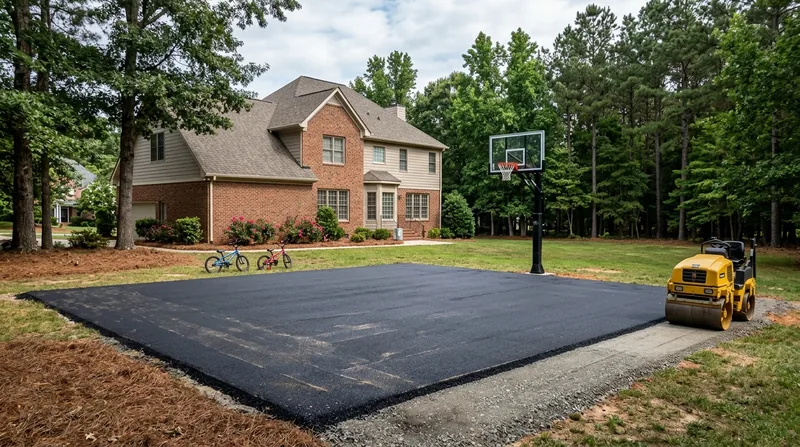




Sports Court & Path Paving in Greensboro means building basketball courts, tennis bases, pickleball surfaces, and walking paths that stay true through Carolina heat, winter freeze-thaw, and the heavy red-clay soil of the Piedmont. Greensboro's sticky clay, 45 inches of annual rain, and summer thunderstorms that wash out edges demand asphalt structures built to hold flat and tight. Whether you're installing a court in Fisher Park, laying a path through a Sedgefield estate, or paving a golf cart trail on a Summerfield property, the surface has to stay level and the base has to shed water. We build the asphalt structure; your court stays true through the seasons. For more on how we handle site-specific paving work, see our asphalt driveway paving and installation page.
Why Sports Court & Path Paving Matters in Greensboro's Residential and Commercial Settings
A backyard basketball court or tennis base is only as good as its foundation. Greensboro's combination of red Piedmont clay, freeze-thaw cycles, and summer heat creates conditions where an undersized or poorly drained asphalt base fails in three to five years. A dead-flat surface is not a luxury; it is the requirement for acrylic color systems, line painting, and playable courts. When the base settles unevenly or water pools, the court becomes unsafe and the acrylic coating begins to fail. Getting the structure right the first time costs less than patching or resurfacing later.
- We measure and grade the site to exact specifications, accounting for Greensboro's clay soil and drainage patterns.
- We compact the base in layers and proof-roll before the asphalt surface course goes down.
- We finish the top course to tight tolerances so your court stays flat for line painting and play.
- We design drainage so water sheds off the edges, not into the clay subgrade.
A properly built court holds its surface and stays playable for fifteen to twenty years with routine maintenance.
Local example: A homeowner in Starmount installed a tennis court on a 1950s lot with native clay and shallow drainage. The first contractor built a thin base without proper compaction. After two winters, the court developed a low spot. We removed the surface, rebuilt the base with proper grading and compaction, and reinstalled. The court has held flat for eight years since. That rebuild cost more than getting it right initially would have.
For more information on how site preparation affects long-term pavement performance, check our page on gravel driveway installation and grading, which covers the same base-preparation principles.
The City of Greensboro and surrounding municipalities have varying rules for impervious surfaces, stormwater management, and utility locates. North Carolina law requires a 811 utility locate before any excavation. Always verify local requirements with your city or county building department before starting work.
How We Build Sports Courts and Paths in Greensboro: A Step-by-Step Process
Every court and path starts with the site. We walk the ground, measure elevations, check drainage, and identify utilities. Greensboro's terrain slopes in all directions, and we use that slope to our advantage. We strip and grade the base, compact it in layers, and proof-roll it under load before we lay asphalt. The surface course goes down hot and tight, finished to the tolerances your court needs.
- We locate all utilities on the property using a 811 call and mark the site before any digging.
- We strip topsoil and grade the subgrade to the slope and elevation your court requires.
- We place and compact the base course, usually recycled asphalt or new stone, in lifts.
- We proof-roll the finished base under a loaded truck to verify compaction and stability.
- We place the surface course hot mix asphalt, grade it dead-flat, and finish it smooth for your acrylic system.
- We let the asphalt cure for six to twelve months before any sealcoating is applied.
The entire process, from first site visit to finished court, usually takes two to four weeks depending on weather and base conditions.
Greensboro example: A homeowner in College Hill wanted a walking path through a wooded lot connecting the main house to a guest cottage. The lot slopes to the west and holds water in clay. We graded a four-foot-wide path with a two-percent cross-slope, built a four-inch base, and topped it with a two-inch surface course. The path drains cleanly and has stayed flat and walkable for six years.
For details on how we handle site preparation on larger projects, see our private road and HOA paving page.
Sports Court & Path Construction Methods and What Each Offers
| Method | Description | Best For |
|---|---|---|
| Full-Depth Asphalt Build | Subgrade preparation, compacted stone base in lifts, hot-mix surface course finished to tight tolerances. | New courts, paths on clay or poor-draining soils, any project where flatness and durability matter. |
| Recycled Asphalt Base with New Surface | Recycled asphalt millings compacted as base, new hot-mix surface course on top, reduces material cost. | Budget-conscious installations where subgrade is stable and drainage is adequate. |
| Overlay on Existing Base | New asphalt surface placed over an existing, stable base if the subgrade and compaction are sound. | Resurfacing an existing court or path that has settled or oxidized but whose base is still good. |
| Tar and Chip Finish | Liquid asphalt binder with stone chips rolled into a compacted base, lower cost, rustic appearance. | Walking paths in rural settings, golf cart trails, budget installations where acrylic coating is not planned. |
Each method is chosen based on your site, budget, drainage, and the finish you want. We recommend the full-depth build for any court that will receive acrylic paint and line markings.
Sports Court & Path Paving Cost in Greensboro: What to Expect
A backyard basketball court or tennis base starts at $8,500 for a small, well-drained site with stable soil and straightforward access. The actual cost depends on the size of the court or path, the condition of the existing ground, how much grading and base work is needed, and whether you are building on clay or stone. A 2,500-square-foot court with a full-depth build on difficult clay soil will cost more than a 1,200-square-foot path on level ground with good drainage. Access matters too: if the site is at the end of a long, narrow driveway or requires equipment to be carried in by hand, labor costs rise. A walkway through a wooded lot in Summerfield with tight tree spacing costs more to install than a straight path on open ground.
The best way to understand cost for your specific project is to get two or three estimates on site. We provide written estimates with tonnage and thickness specifications so you can compare apples to apples. For a full pricing overview and to schedule a free estimate, visit our pricing page or call (336) 962-5692.
Sports Court & Path Paving Near Me: What to Look For When Hiring a Contractor in Greensboro
When you are ready to hire someone to build a court or path, verify that the contractor is fully insured and carries liability and workers' compensation coverage. Ask for references from recent projects in Greensboro, High Point, Winston-Salem, or surrounding towns and call them. Get the estimate in writing with the thickness and tonnage of asphalt specified so you can compare bids fairly. Avoid contractors who show up unsolicited at your door, offer a price without measuring the site, ask for a large cash deposit before work begins, or have out-of-state plates and no local address. Those are the classic markers of paving fraud in this region.
- Verify the contractor is fully insured and ask for a certificate of insurance before signing a contract.
- Ask for at least two references from completed projects in your area and follow up with a phone call.
- Get the estimate in writing with the asphalt thickness, base material, and total tonnage clearly stated.
- Verify that the contractor understands local permitting and utility-locate requirements in your municipality.
- Check that the contractor is prepared to handle stormwater and drainage according to local code.
- Confirm that the contract includes a start date, an expected completion date, and a clear scope of work.
If your property is in a homeowners association or a master-planned community like Adams Farm, Starmount, or Sedgefield, check the HOA architectural standards before you hire. Some HOAs restrict the color or material of driveways and paths. Verify those rules with your HOA board before you commit to a contractor. For a free estimate and a conversation about your specific project, contact us or call (336) 962-5692.
Sports Court & Path Paving in Greensboro: Pricing Guide
| Service | Price | Details |
|---|---|---|
| Backyard Basketball Court | Starting at $8,500 | Includes site prep, compacted base, and finished asphalt surface for a 2,000-2,500 sq ft court |
| Tennis or Pickleball Court | Starting at $9,200 | Tight-tolerance flat finish, proper drainage, and base suitable for acrylic color systems |
| Walking Path or Golf Cart Trail | Starting at $6,500 | Per 500-1,000 linear feet depending on width, grading, and soil conditions in Greensboro area |
| Complex Site or Large Installation | On estimate | Extensive grading, difficult drainage, wooded terrain, or multiple courts require site visit and measurement |
| Estimate and Site Visit | Free | Response within 24 hours, written quote with tonnage and thickness, no obligation to book |
Indicative pricing, the exact cost depends on square footage, finish, and site access. Free personalized estimate within 24h at (336) 962-5692.


