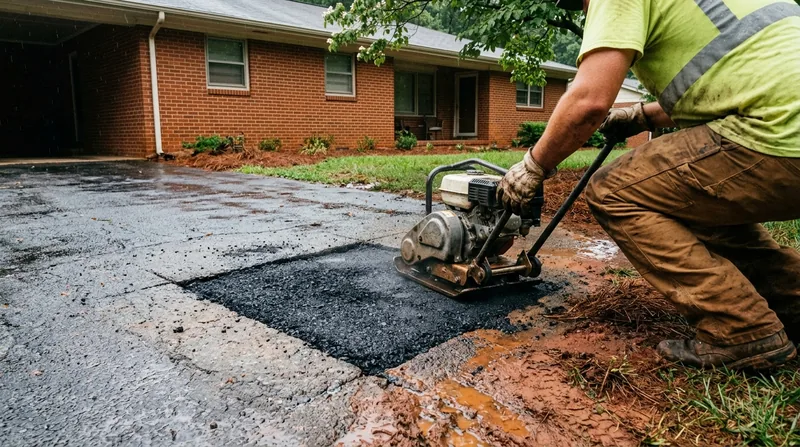




Pothole Repair & Asphalt Patching in Greensboro is not a luxury, it is emergency maintenance. The Piedmont clay that underlies Greensboro, High Point, Winston-Salem, and the surrounding Triad holds water like a sponge after the 45 inches of rain this region receives annually. Ice storms, tropical-storm remnants, and the freeze-thaw cycle of winter nights crack the asphalt surface and undercut the base. A single pothole that starts in January can become a failed section by spring if it is not cut out and patched properly. We assess potholes quickly, remove the failed material, and fill the hole with compacted hot mix or infrared recycled surface so the damage stops spreading and your driveway or parking lot stays safe to drive on.
Why Potholes Form Fast in Greensboro and the Piedmont
Greensboro sits on sticky red clay that expands when wet and shrinks when dry. When rain saturates the base under asphalt, the clay loses bearing capacity. Freeze-thaw cycles in winter push water up through cracks, and the ice expands beneath the surface. When the ice melts, it leaves a void. Traffic then breaks the weakened asphalt into the void, and within days a small crack becomes a pothole. The hot, humid summers oxidize and soften the binder in the asphalt, making it more brittle and prone to cracking. This combination of water, frost, heat, and traffic makes potholes inevitable in this climate.
- Water infiltration under the asphalt weakens the clay base and opens voids.
- Freeze-thaw cycles expand ice beneath the surface and crack the pavement from below.
- Summer heat oxidizes the asphalt binder and makes the surface more brittle.
- Traffic breaks through weakened asphalt into the void, and the pothole expands.
- Untreated potholes spread the damage to surrounding pavement and worsen drainage.
Catching potholes early and patching them correctly stops the failure from spreading and extends the life of the rest of the pavement.
Key info: A pothole that is one inch deep and six inches wide can become a two-foot crater within a month if left unrepaired. The sticky clay base here accelerates the failure. Patching in winter is harder because the asphalt does not compact as well in cold, but we can still do it. Spring and fall are ideal for lasting repairs.
How We Patch Potholes in Greensboro: Two Proven Methods
We use two approaches to patch potholes, and the choice depends on the size, location, and how much of the surrounding asphalt is still sound. For isolated potholes and small failed sections, we cut the hole square, clean it, tack-coat the walls and base, and fill it with compacted hot mix. For larger areas or when you want a seamless repair with no cold joint, we use infrared patching, which heats the existing asphalt surface in place, recycles it, and blends it with new material so there is no visible seam. Both methods are durable and hold up to freeze-thaw cycles here in the Piedmont.
- We excavate the pothole to solid base, remove all loose material, and square the edges.
- We clean the hole with compressed air and apply tack coat to bind new asphalt to the old.
- We place and compact hot mix in lifts, with each layer compacted to density before the next layer.
- For infrared patching, we heat the surrounding asphalt, mill it in place, add new binder and mix, and compact it seamlessly.
- We finish the patch level with the surrounding pavement so drainage and traffic flow normally.
Both methods cure and are ready for traffic immediately after compaction, so your driveway or lot does not stay closed.
Local example: A residential driveway in Fisher Park or Starmount with a single pothole near the garage apron can be patched in an hour with square-cut hot mix. A parking lot at a Battleground Avenue retail strip with multiple potholes across the surface may benefit from infrared patching to avoid cold joints that can re-open. We assess the scope on site and recommend the method that gives you the longest life.
For more detail on other repair options like asphalt resurfacing and overlay when patching is not enough, see our full repair guide.
| Approach | Description | Best for |
|---|---|---|
| Square-Cut Hot Mix Patch | Excavate pothole to solid base, tack-coat, and fill with compacted hot asphalt in lifts. | Single or isolated potholes, small failed areas, residential driveways. |
| Infrared Recycled Surface Patch | Heat the existing asphalt surface, mill it in place, blend with new material, and compact seamlessly. | Multiple potholes, larger failed areas, parking lots, where seamless finish is desired. |
| Cold Patch (Temporary) | Cold-mix asphalt applied without heating, sets over time, lower compaction density. | Emergency temporary fill in winter when hot mix cannot be placed, replaced with hot mix in spring. |
| Full-Depth Replacement Section | Excavate failed area to base, rebuild base if needed, place new full-depth asphalt. | When pothole exposes failed base, when surrounding asphalt is severely cracked, or when base is unstable. |
Pothole Repair & Asphalt Patching Cost in Greensboro: What to Expect
Pothole patching typically starts at $450 for a single isolated pothole or small failed section, including excavation, cleanup, tack coat, and compacted hot mix. The final cost depends on how many potholes need repair, how deep they are, whether the base is sound or needs rebuilding, and whether you choose standard square-cut patching or infrared seamless repair. A parking lot with five to ten potholes scattered across the surface may run $1,500 to $3,500 depending on size and depth. If the pothole is part of a larger failed section or if the base is compromised, the repair may escalate to a resurfacing or overlay project, which is a different scope and price.
We recommend getting two or three estimates so you can compare approach, material, and price. A written estimate should specify the number and size of potholes, the depth of excavation, the tonnage of asphalt to be placed, the compaction method, and the timeline. Avoid any estimate that gives only a per-square-foot figure without on-site measurement and material specs. Call us at (336) 962-5692 for a free, no-obligation estimate with tonnage and thickness detail, or visit our full pricing overview for context on other repair services.
Pothole Repair & Asphalt Patching Near Me: What Greensboro Homeowners and Property Managers Should Know
When you are looking for pothole repair near Greensboro, verify that the contractor you choose is fully insured and carries a current certificate of liability. Ask for references from recent jobs in your neighborhood, and check whether the estimate includes a written scope with tonnage and compaction specs. If your driveway or lot is in an HOA community like Starmount, Sedgefield, or Hamilton Lakes, confirm that the patching material and finish meet your HOA architectural standards before work begins. For parking lots or driveways with a curb cut or driveway apron, some municipalities in the Triad require permits, so ask whether permits are needed for your specific address and whether we will help you navigate the local building department. Our team is local, fully insured, and can answer permit questions for your jurisdiction.
- Verify that the contractor carries liability insurance and can provide a current certificate on request.
- Request a written estimate with pothole count, excavation depth, asphalt tonnage, and compaction method specified.
- Ask for references from at least two recent jobs in Greensboro, High Point, or Winston-Salem.
- Confirm that HOA rules do not restrict the material or finish of the repair if your property is in a managed community.
- Check with your local building department or HOA to determine whether a permit is required before work begins.
We are based in Greensboro, fully insured, and happy to walk you through the permitting process and give you honest guidance on whether patching is the right fix or whether your driveway needs resurfacing or replacement. Contact us today for a free estimate and a straightforward conversation about your pavement.
Pothole Repair & Asphalt Patching in Greensboro: Pricing Guide
| Service | Price | Details |
|---|---|---|
| Single Pothole or Small Failed Section | Starting at $450 | Includes excavation to solid base, cleanup, tack coat, and compacted hot mix; depth and size determine final cost |
| Multiple Potholes (5-10 across lot or drive) | Starting at $1,500 | Total cost depends on individual pothole depth, spacing, and whether base is sound or needs rebuild work |
| Infrared Seamless Recycled Surface Patch | Starting at $600 | Heat, mill, and reblend existing asphalt in place; higher cost offset by no cold joint and longer durability |
| Large Failed Section or Base Rebuild Required | On estimate | Requires on-site assessment to determine excavation depth, base condition, and full-depth versus patch approach |
| Free Estimate | No charge | Call (336) 962-5692 for response within 24 hours; includes on-site measurement, tonnage specs, and written quote |
Indicative pricing, the exact cost depends on square footage, finish, and site access. Free personalized estimate within 24h at (336) 962-5692.


