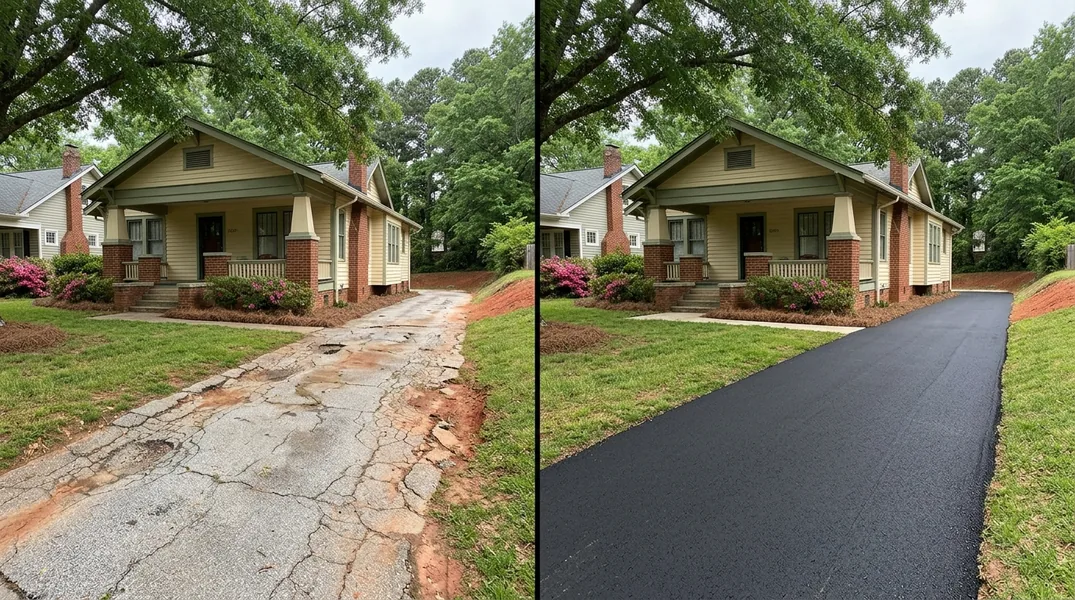
Understanding Greensboro's Red Clay Challenge
If you live in Greensboro, you've likely noticed the distinctive reddish soil that surrounds our community. This red clay is beautiful in many ways, but it presents a unique challenge for homeowners choosing between asphalt vs concrete driveway materials. Red clay has high moisture retention and expands and contracts with seasonal changes, which can wreak havoc on improperly installed or maintained driveways.
The Piedmont region where Greensboro sits has soil with iron oxide content that makes it particularly reactive. When water penetrates the soil beneath your driveway, the clay swells. When it dries, it shrinks. This constant movement puts stress on whatever surface sits on top of it. Understanding how your driveway material responds to these conditions is essential before making your investment.
Asphalt Driveways and Red Clay Soil Compatibility
Asphalt Driveway Paving & Installation has become the preferred choice for many Greensboro homeowners dealing with red clay soil. Asphalt's flexible nature allows it to move slightly with the ground beneath it, rather than fighting against the soil's expansion and contraction. This flexibility is one of the biggest advantages when dealing with clay-heavy terrain. A blacktop driveway can accommodate minor ground shifts without cracking, whereas rigid materials struggle with the same conditions.
The asphalt driveway lifespan in Greensboro typically ranges from 15 to 20 years with proper maintenance and care. This lifespan assumes you're addressing issues promptly through Driveway Repair services when small cracks appear. The key to maximizing your asphalt investment in our region is regular seal coating every 2 to 3 years and prompt attention to any surface damage. When you catch problems early, you avoid expensive full replacements and extend your driveway's useful life considerably.
How Concrete Performs Against Red Clay Movement
Concrete driveways offer a different approach to the red clay problem. While concrete is incredibly durable and can last 25 to 30 years or more, its rigid structure makes it vulnerable to the ground movement that red clay creates. When clay soil expands beneath a concrete slab, the concrete can't flex, leading to cracks, heaving, and settling. These aren't cosmetic issues; they can compromise the structural integrity of your driveway and create safety hazards.
The initial appeal of concrete is understandable. It requires less frequent maintenance than asphalt, doesn't need seal coating, and presents a cleaner aesthetic. However, in areas with significant clay soil activity like Greensboro, those cracks often appear within just a few years of installation. Once concrete cracks, water seeps into the base layer, accelerating deterioration. Repairing concrete is also more expensive than addressing similar issues in asphalt, making it a costlier long-term choice for homeowners in our region.
Asphalt Over Concrete Driveway: A Hybrid Solution
Some homeowners in Greensboro wonder if they can place asphalt over concrete driveway surfaces, and the answer is yes, with proper preparation. This approach can be cost-effective if your existing concrete is in relatively good condition with only minor cracks. Asphalt Resurfacing & Overlay allows you to avoid the expense of concrete removal while gaining the flexibility benefits of asphalt.
The process involves cleaning the concrete surface, filling any significant cracks, and then applying a new asphalt layer on top. This creates a fresh, functional driving surface that can handle red clay soil movement better than the original concrete. However, this solution works best when the underlying concrete is structurally sound. If your concrete has severe heaving, settling, or extensive cracking, overlaying with asphalt will only delay problems rather than solve them. The asphalt layer will eventually reflect the movement of the compromised concrete beneath it.
Maintenance Requirements: Asphalt vs Concrete in Red Clay Areas
Maintenance differences between these two materials become especially important when you're managing red clay soil conditions. Asphalt requires proactive care, but that care is relatively straightforward and affordable. Seal coating every 2 to 3 years protects the surface from moisture penetration and UV damage. Prompt attention to small cracks through Pothole Repair & Asphalt Patching prevents water from reaching the base layer and causing more extensive damage.
Concrete, by contrast, requires less frequent maintenance but is more expensive to repair when problems arise. Once cracks develop in concrete, they're difficult to seal effectively, and water will continue to penetrate. In red clay areas, this creates a vicious cycle where ground movement causes new cracks faster than you can repair them. Many Greensboro homeowners find that the lower maintenance burden of concrete is offset by higher repair costs and shorter effective lifespan in our soil conditions.
Asphalt Driveway Paving & Installation Cost in Greensboro: What to Budget
When comparing asphalt vs concrete driveway options, cost is naturally a significant factor. The initial pricing for asphalt installation is typically lower than concrete, usually ranging from $3 to $5 per square foot for a standard residential driveway. Concrete generally costs $4 to $8 per square foot initially, so concrete appears more expensive upfront. However, this comparison becomes more nuanced when you factor in the total cost of ownership over the driveway's lifespan.
When you account for maintenance, repairs, and the actual useful life in Greensboro's red clay environment, asphalt often proves more economical. Seal coating costs $100 to $300 annually, while major repairs are typically $300 to $1,000 depending on damage extent. Concrete repairs, when they're needed, often cost $500 to $2,000 or more. Given that concrete driveways in clay soil frequently require repairs within 5 to 10 years, homeowners often spend more on concrete over time despite the lower initial cost. Contact Greensboro Asphalt Paving at (336) 962-5692 to discuss your specific situation and get an accurate free estimate tailored to your property.
Making Your Decision: Which Material is Right for Your Greensboro Home
Your choice between asphalt and concrete should reflect the realities of Greensboro's soil conditions and your personal preferences. If you prioritize flexibility, lower initial cost, and proven performance in clay soil, asphalt is the stronger choice. If you prefer minimal maintenance and don't mind investing more upfront and in repairs, concrete might appeal to you, though it requires excellent base preparation to minimize problems.
The most important factor is working with experienced professionals who understand local soil conditions. Proper installation, including adequate base preparation and drainage, matters more than the material choice itself. Whether you choose asphalt or concrete, poor installation will lead to premature failure. That's why it's worth investing in a contractor who knows how to build driveways that stand up to Greensboro's specific challenges. Greensboro Asphalt Paving has years of experience handling red clay conditions and can help you choose the best solution for your home. Call (336) 962-5692 or request a free estimate today to discuss your driveway project with our team.
Looking for a professional asphalt paving contractor in Greensboro? Greensboro Asphalt Paving responds fast for all your asphalt paving needs.
Get a Free Quote